

Here's What South Florida Homeowners Need to Know . . .
If you own a home in South Florida — or you've been thinking about buying one— you've probably heard the buzz. Governor Ron DeSantis just made a major announcement, and it has the potential to reshape homeownership in Florida in a way that hasn't been done anywhere in the country.
Dean Kwiatkoski, a Realtor with a Mortgage lending background talks to us from his office at Signature International Real Estate.
Dean has spent over two decades helping buyers and sellers navigate the South Florida market.
He understands the full financial picture of homeownership better than most. And right now, he says this is a conversation every South Florida homeowner and prospective buyer needs to be paying attention to.
This is one of the biggest policy shifts I've seen in my entire career," says Mr. Kwiatkoski.
"Whether it ultimately passes or not, the fact that we're having this conversation at the highest level of state government tells you something important about where Florida is headed."
On May 27, 2026, Governor DeSantis announced a plan called
"Save Our Homes from Excessive Property Taxes" and called for a
special legislative session beginning the week of June 1 to consider placing a constitutional amendment on the November 2026 ballot.
The numbers behind the proposal are striking. Property tax revenue collected by local governments has nearly doubled in just seven years — from $32 billion to $60 billion — and is projected to hit $83 billion by 2032. DeSantis called that trajectory "astounding" and said Florida homeowners need relief now.
The plan has five major components:
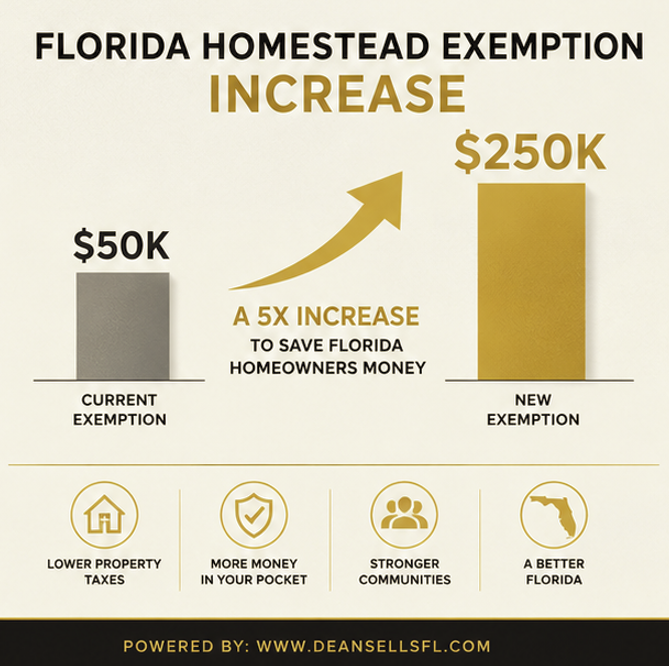
 1. Exempt Homestead Properties From Taxation. The first
$250,000 of a homesteaded home's assessed value would be immediately exempt
from taxation, with a legislatively mandated schedule for full elimination of
property taxes on primary residences.
2. Ensure Funding for Core Services. Any remaining property tax revenue would be restricted to core public needs — public safety, schools, infrastructure, and natural resources. No more using property tax dollars for programs that divide rather than unite communities.
3. Protect Small Businesses. Property tax assessment increases on businesses would be capped, dropping from 10% to 5%, creating a more stable environment for local entrepreneurs.
4. Ensure Fairness for Florida Residents. New residents establishing Florida residency after January 1, 2027 would need to maintain that residency for up to five years before qualifying for the full homestead exemption increase. The Governor has been direct: long-time Floridians should benefit first.
5. Create a State Trust Fund. A multibillion-dollar trust fund would be established to help local governments manage the transition and continue delivering essential services.

── What Does "Eliminating Property Taxes" Actually Mean? ──
Here's where it's important to read the fine print — and
this is exactly where Dean's mortgage lending background proves valuable for his clients.
"I always tell buyers, don't just hear the headline —understand the mechanics," says Dean Kwiatkoski. "The proposal
doesn't eliminate all property taxes. School district taxes are not included in this relief. What it targets is the non-school portion of your ad valorem taxes
— the county, city, and special district levies — which for most homeowners represents the bulk of their annual bill."
The plan would cover approximately 92% of Florida homeowners who own and occupy their primary residence, DeSantis said. If passed, this would be the most significant property tax reform in U.S. history.
But there's a critical detail every buyer needs tounderstand: this relief applies only to homesteaded properties — meaning your
primary residence. Vacation homes, investment properties, and rentals do not qualify.
── What Hurdles Does It Still Face? ──
This proposal is bold, but it is far from a done deal.
To reach the November 2026 ballot, the constitutional
amendment must pass both chambers of the Florida Legislature by a 60%
supermajority during the special session. Then, Florida voters must approve it
by that same 60% threshold in November.
It's worth noting that an earlier version of this
legislation — HJR 203, which proposed a phased ten-year approach — passed the
Florida House 80 to 30 in February 2026, a strong vote by any measure. However,
it died in the Senate Appropriations Committee when the regular session ended
in March without ever receiving a hearing.
"The House has shown real appetite for this," says
Mr. Kwiatkoski. "The Senate has been more cautious, which is why this special session matters so much. The Governor calling the Legislature back signals that there is political will to push this across the finish line."
── What This Could Mean for South Florida Buyers and Homeowners ──
For anyone considering a home purchase in Palm Beach County, Broward County, or anywhere in South Florida, the implications are worth understanding now — even before anything is finalized.
According to Dean Kwiatkoski, the potential impact runs in two directions. "On one hand, eliminating or significantly reducing
property
 taxes could meaningfully lower the monthly cost of homeownership.
That's money back in homeowners' pockets every single year," he says.
"On the other hand, economists have pointed out that when buyers suddenly
have more purchasing power, home prices in supply-constrained markets — like
South Florida — can adjust upward to absorb that relief."
taxes could meaningfully lower the monthly cost of homeownership.
That's money back in homeowners' pockets every single year," he says.
"On the other hand, economists have pointed out that when buyers suddenly
have more purchasing power, home prices in supply-constrained markets — like
South Florida — can adjust upward to absorb that relief."
In other words, the tax savings might be partially offset by higher purchase prices in competitive markets. It's a nuance that matters enormously for first-time buyers, and one that Dean discusses openly with his clients.
"I'd rather my buyers go in with a clear picture than be surprised later," says Mr. Kwiatkoski. "That's always been my approach — help you understand the full financial landscape so you can make the
decision that's right for your situation."
── The Bottom Line: Watch This Space ──
Florida property tax elimination — even in partial form — would be historic. The Governor's Save Our Homes proposal represents the most aggressive push toward property tax relief the state has ever seen, and South
Florida homeowners and buyers are right to be paying close attention.
Here's where things stand as of this writing: No changes to current property taxes have taken effect. Buyers, sellers, and homeowners
should continue planning based on today's tax structure while monitoring developments from the special session.
"If this passes voters in November, it changes the financial calculus of buying a home in South Florida in a real and significant
way," says Dean Kwiatkoski. "And if it doesn't pass, there will be more proposals coming. This conversation isn't going away."
If you have questions about what the proposed Florida property tax elimination could mean for your specific situation — whether
you're buying, selling, or simply trying to protect the value of the home you already own — I'd love to talk it through with you.
“No pressure. No sales pitch. Just a real conversation”.
USEFUL TOOL:
To calculate your possible savings, go to: https://www.saveourhomesfl.com/
“Enter your street address /see how much you could save”
Dean Kwiatkoski | Realtor & Local Expert
Signature International Real Estate
Serving South Florida — Palm Beach & Broward
📱 561-948-3480 | 📧 dean@deanksellshomes.com | 🌐www.DeanKSellsHomes.com